For the convolutional layer we have used 32 filters with a kernel size of 5 x 5. The activation function used is Relu activation function.The input tensor is of size . A 5 x 5 size window will slide along the 28 x 28 size input image. Here the padding and stride parameters are not mentioned so the default values of stride of 1 and padding of 0 will be applied. After the convolution layer a max-pooling of 2 x 2 window is applied.

A second group of layers has been stacked with 64 filters and 5 x 5 kernel in the convolutional layer and 2 x 2 window in the max-pooling layer. Each block has one or more convolutional layers and one max-pooling layer successively. We randomly divided 40,000 training images and 10,000 validation images from the original training images. Observing this summary, it is easily appreciated that in the convolutional layers is where more memory is required and, therefore, more computation to store the data. In contrast, in the densely connected layer of softmax, little memory space is needed but, in comparison, the model requires numerous parameters which must be learned. An example of basic convolutional neural network structureIn this section, we illustrate an example of 2D CNN for image classification using the Keras context to see the structure of CNN.

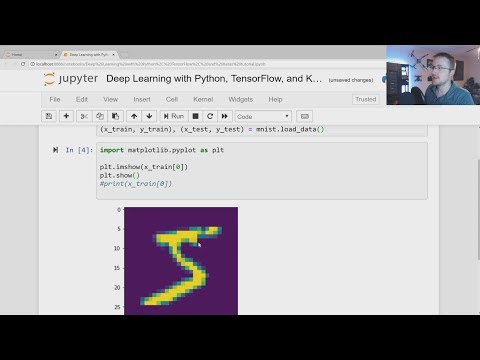
Suppose each input is a gray-scaled image with the height and width of 28 pixels each. Each pixel has one single channel and the input has a shape that is the input shape of MNIST images. The number of channels are 3 if we consider color images with RGB values.

We consider a CNN structure with two convolution-pooling layers repeated. We know well about Dense layers, activation functions and a Sequential model through this deep learning fundamentals article. Here, we discuss the convolution layer, Flatten layer and the way they work. In the above code, we have instantiated a Conv2D layer with a few arguments. The first argument, 64 refers to the number of kernels . The second argument refers to the size of those kernels.

The last argument refers to the input shape of images (mostly in three dimensions- height, width, colour channels). ConclusionIncreases in computer resources and data size have resulted in more people paying attention to deep learning. Keras helps those people quickly get used to deep learning methods by using some core functions. Deep neural network is useful for supervised learning with unconventional data like images and texts. We organized the concepts in deep learning for statisticians in terms of parameter estimation procedures and advanced techniques that make a model performs better.

We describe the computation of a deep network in the matrix form to understand its procedure more clearly. Another important feature is that convolutional layers can learn spatial hierarchies of patterns by preserving spatial relationships. For example, a first convolutional layer can learn basic elements such as edges, and a second convolutional layer can learn patterns composed of basic elements learned in the previous layer. This allows convolutional neural networks to efficiently learn increasingly complex and abstract visual concepts. The convolutional layer in convolutional neural networks systematically applies filters to an input and creates output feature maps.

We can model a convolutional neural network to develop an image classifier. However, a convolution layer expects three dimensional data input. Since we possess grayscale images, their shapes are of . We should increase the number of dimensions from 2 to 3 by expanding at the last axis. 'Stride' is the number of pixels that a filter moves by at once inside an input.

If it is one, the filter moves right one pixel at a time. In the default setting, we usually set strides equal to one for convolutional layers, and same value as pool size for pooling layers. If the value of stride and pooling kernel size are the same, it prevents each kernel from being overlapped. The goal of training CNN is to extract important features from input images that decide a unique class of each image by learning all weights in the filters. If we use a large filter, the model tries to find features in a large area of the input at each computation, whereas setting the filter size small makes the network view a small area. This is one of the tuning parameters that enables setting the different filter size depending on what we expect from the model.

How to calculate output shape in 3D convolution, If I apply conv3d with 8 kernels having spatial extent without padding, how to calculate the shape of output. If the next layer is max pooling For example, this is one layer of input to convolution layer 5x5 and the filter size is 3x3. When we slide the filter over the image it can be applied only on the red line surrounded pixels . We would like to point out to the reader that the assumption we have made is that the window moves forward 1 pixel away, both horizontally and vertically when a new row starts. Therefore, in each step, the new window overlaps the previous one except in this line of pixels that we have advanced.

But, as we will see in the next section, in convolutional neural networks, different lengths of advance steps can be used . In convolutional neural networks you can also apply a technique of filling zeros around the margin of the image to improve the sweep that is done with the sliding window. The parameter to define this technique is called "padding", which we will also present in more detail in the next section, with which you can specify the size of this padding. This layer creates a convolution kernel that is convolved with the layer input over a single spatial dimension to produce a tensor of outputs. If use_bias is True, a bias vector is created and added to the outputs.
Finally, if activation is not None, it is applied to the outputs as well. And after stacking several 1D convolutional layers, you might be reaching a layer in which the input dimensionality is smaller than the kernel size. This happens because the default value for the argument padding is 'valid', which means that the input is not padded.

Varied the number and size of filters, fixing the number of convolutional layers to 1 and applied models on seven datasets for Sentence Classification. They found the number and size of filters could have important effects and should be tuned. Users can construct their CNN models with some experiments on the depth of layers, number of filters and their size. Output_padding An integer or list of 2 integers, specifying the amount of padding along the height and width of the output tensor.

Can be a single integer to specify the same value for all spatial dimensions. The amount of output padding along a given dimension must be lower than the stride along that same dimension. This can become a problem as we develop very deep convolutional neural network models with tens or hundreds of layers.

We will simply run out of data in our feature maps upon which to operate. If use_biasis True, a bias vector is created and added to the outputs. Convolution layers, In Keras, you create 2D convolutional layers using the keras.layers.Conv2D() function.

Table 10, particularly in the convolutional, pooling, and dense layer. Table 9 shows the results of error rates on the 10,000 test images. We using the validation images to select the best model in each structure and compared the performances on the test images.
In summary, test error decreases as the number of convolutional layers per block increases. The batch normalization techniques in convolutional layers are also helpful. However, additional deep hidden dense layers do not improve the test performance consistently. Although the convolutional layer is very simple, it is capable of achieving sophisticated and impressive results. The idea that we want to give with this visual example is that, in reality, in a convolutional neural network each layer is learning different levels of abstraction.

The reader can imagine that, with networks with many layers, it is possible to identify more complex structures in the input data. ImageNet classification with deep convolutional neural networks, Advances in Neural Information Processing Systems, 25,. Each pixel value becomes an independent feature of an image.

Therefore, we used 786 predictor variables including 784 different pixel values and two summary statistics - mean and standard deviation of all pixels. We adjusted some parameters in the Random Forest that included the number of randomly sampled as candidates at each split and selected the best values by comparing OOB error rates. The good thing is that most neural network APIs figure the size of the border out for us. All we have to do is just specify whether or not we actually want to use padding in our convolutional layers. This layer creates a convolution kernel that is convolved with the layer input to produce a tensor of outputs.

You can import a Keras network with multiple inputs and multiple outputs . Use importKerasNetwork if the network includes input size information for the inputs and loss information for the outputs. The importKerasLayersfunction inserts placeholder layers for the inputs and outputs. After importing, you can find and replace the placeholder layers by using findPlaceholderLayers and replaceLayer, respectively.

The workflow for importing MIMO Keras networks is the same as the workflow for importing MIMO ONNX™ networks. For an example, see Import and Assemble ONNX Network with Multiple Outputs. To learn about a deep learning network with multiple inputs and multiple outputs, see Multiple-Input and Multiple-Output Networks. Here we can see our first two Conv2D layers have a stride of 1×1.

The final Conv2D layer; however, takes the place of a max pooling layer, and instead reduces the spatial dimensions of the output volume via strided convolution. Finally, ifactivation is not None, it is applied to the outputs as well. We have built our convolutional neural network for our Computer Vision task. Here, we define an optimizer, a loss function and a metric required to train and evaluate the model.

We use an Adam optimizer , sparse categorical cross-entropy loss function (for multi-class classification) and accuracy metric. Advanced techniques for training DNNIn a large deep neural network for a supervised learning, the model contains a huge number of parameters and is often very complex. The performance sometimes becomes poor on a validation or a hold-out test set if the model is too complex.

This 'overfitting' problem frequently occurs in many machine learning models. A typical CNN structure for a classification stacks one convolutional layers and pooling layers alternately which conduct feature extraction and subsampling. The final output features from those stacked blocks are flattened and fully-connected with all nodes of the output layer and conduct classification.

One can consider adding more than one FC hidden layers right before the final output layer in order to improve classification performance. This is actually the default for convolutional layers in Keras, so if we don't specify this parameter, it's going to default to valid padding. Since we're using valid padding here, we expect the dimension of our output from each of these convolutional layers to decrease. In this post, we're going to discuss zero padding as it pertains to convolutional neural networks. Conv2D layers in between will learn more filters than the early Conv2D layers but fewer filters than the layers closer to the output. Dilation_rate - Dilated convolution is a convolution that is only applied to inputs with defined gaps.

To control this dilated convolution dilation_rate parameter is used. Dilated convolution can be used when we require fine-grain details even when working with high-resolution images and our neural network has less number of parameters. In a convolutional neural network, a convolutional layer is responsible for the systematic application of one or more filters to an input. Filters − It refers the number of filters to be applied in the convolution.

Kernel size − It refers the length of the convolution window. Strides − It refers the stride length of the convolution. If the sliding kernel moves through more cells at a time, the output matrix size will be reduced. Further, padding may be optionally performed to give more importance to the edges of the input image.

Step C. Backward passMany machine learning algorithms use Gradient Descent methods to update parameters to gradually reduce the objective function value and reach the optimum in the end. Loss function defined as an objective in the deep network is a differential function for a parameter set of individual weights . Therefore, it is possible to compute the differentials of the loss, or gradient vector for weights in each layer. The model can update the weight in the descent direction of the loss after obtaining a gradient for a certain weight making up the loss as follows. For example, suppose that we set them all zero or a certain identical constant. The initial learning step uses those parameters for computation in all layers from input to output.
If they are all zeros, the initial outputs from the network become zeros and good-for-nothing for the following steps. If they are all same constants, they act like just one neuron regardless of the number of nodes and neurons in the network. So we need to choose different values in a reasonable range.
The choice of the initial values depends on activation functions in the network. Data_formatA string, one of channels_last orchannels_first. The ordering of the dimensions in the inputs.channels_last corresponds to inputs with shape while channels_first corresponds to inputs with shape . It defaults to the image_data_format value found in your Keras config file at ~/.keras/keras.json. Kernel_sizeAn integer or list of 2 integers, specifying the width and height of the 2D convolution window. The dilation_rate parameter of the Conv2D class is a 2-tuple of integers, controlling the dilation rate for dilated convolution.

Dilated convolution is a basic convolution only applied to the input volume with defined gaps, as Figure 7 above demonstrates. Data_format A string, one of channels_last orchannels_first. Kernel_size An integer or list of 2 integers, specifying the width and height of the 2D convolution window. Of note is that the single hidden convolutional layer will take the 8×8 pixel input image and will produce a feature map with the dimensions of 6×6.


